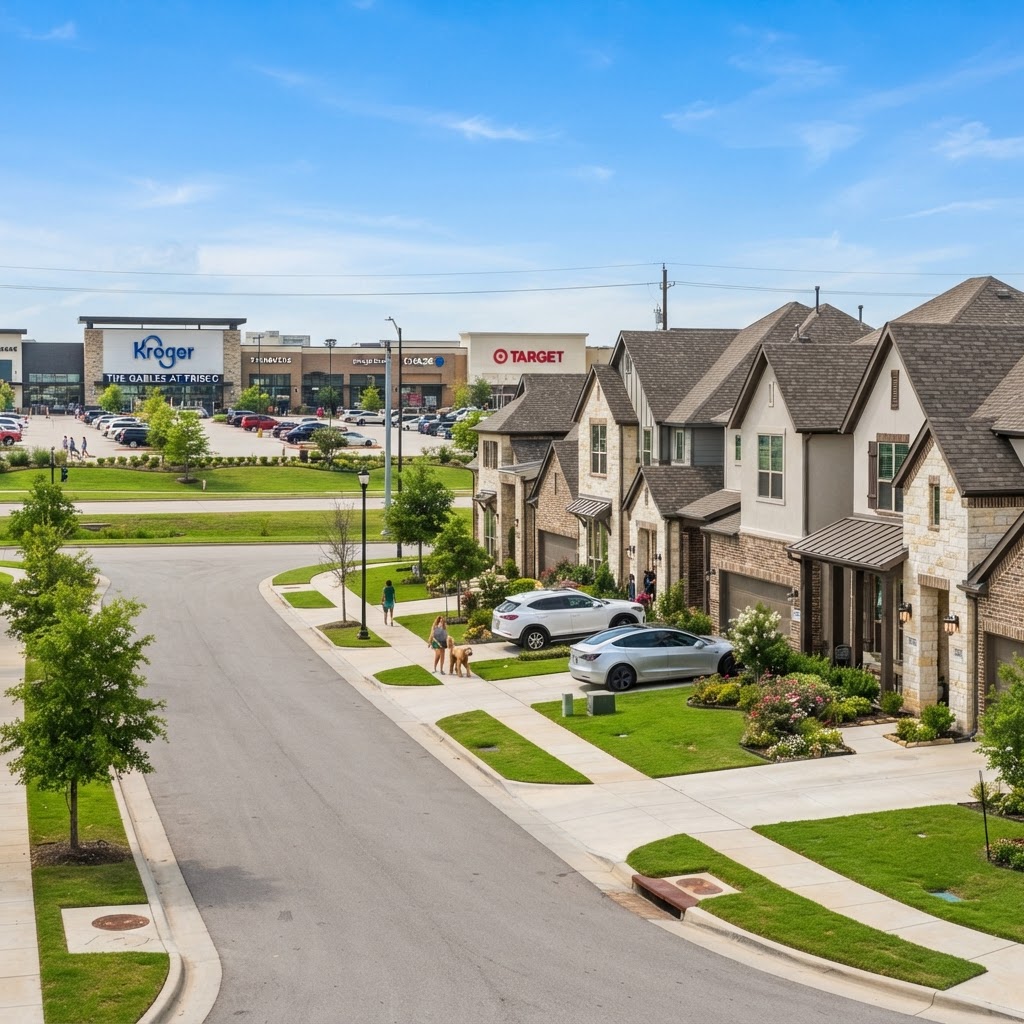
The Real Cost of Living in Frisco, Texas
Frisco consistently ranks among America's fastest-growing and best places to live — but what does it actually cost to live here? If you're relocating from California, the Midwest, or anywhere outside DFW, the numbers can surprise you in both directions: housing is cheaper than coastal markets but steeper than most of Texas, and property taxes demand real planning.
This is the no-fluff breakdown of what Frisco residents actually pay in 2026, with a sample monthly budget you can adapt to your situation.
Housing: The Single Biggest Line Item
Housing dominates any Frisco budget. The median home price in Frisco sits around $650,000 in 2026, with new construction in master-planned communities like The Fields and Starwood ranging from $700K to well over $1.5M. Resale homes in established neighborhoods like Stonebriar Park and Edgestone at Legacy typically range $500K–$800K.
For a median-priced $650K home with 20% down on a 6.8% mortgage, your monthly principal and interest runs about $3,420. Add property taxes (~$1,200/month) and insurance (~$200), and your all-in housing cost lands near $4,800/month before utilities.
SAMPLE FRISCO HOUSING MATH
Property Taxes: The Texas Trade-Off
Texas has no state income tax — but it funds government through property taxes, and Frisco's rates are among the higher end in DFW. The combined rate (city + Collin/Denton County + Frisco ISD) runs roughly 2.2–2.4% of assessed value. On a $650K home, that's $14,000–$15,500 per year.
For relocating buyers from California or the Northeast, this is often the sticker-shock moment. But the math still favors Texas for most high earners: a $200,000 household income in California can pay $13,000+ in state income tax — roughly equal to Frisco's property tax bill — while enjoying a lower overall cost base and no capital gains tax complications.
Utilities: Texas Summers Are Real
Electricity is the utility wildcard. Frisco's summer heat drives AC usage hard — expect $300–$450/month for a 2,500 sqft home during June–September, dropping to $120–$200 in spring and fall. Annualized, budget about $2,800–$3,600/year for electricity.
Water, sewer, and trash typically run $80–$140/month combined. Gas (winter heating) adds $40–$120/month seasonally. Internet runs $70–$120 for fiber or cable. Total utilities average $400–$600/month year-round for a family home.
Transportation
Frisco is car-dependent — there's no light rail and commutes run 25–45 minutes to major employment centers. Budget for two vehicles: $700–$900/month combined including car payments, insurance, gas, and maintenance. The Dallas North Tollway and Sam Rayburn Tollway add toll costs for many commuters — figure $100–$200/month if you use them daily.
Groceries, Dining, and Everyday Costs
Frisco's grocery costs run about 5% below the U.S. average thanks to heavy competition (H-E-B, Kroger, Whole Foods, Market Street, Trader Joe's, Costco). A family of four typically spends $900–$1,300/month on groceries. Dining out is abundant — Frisco has one of DFW's best restaurant scenes — and a typical dinner for two at a mid-range restaurant runs $70–$120 before drinks.
Childcare and Education Costs
Full-time daycare for one child in Frisco runs $1,200–$1,800/month. Frisco ISD public schools are free and among the best in Texas — a major reason families accept the housing premium. Private school options (Legacy Christian, Frisco's faith-based academies) run $12,000–$22,000/year per child.
Sample Monthly Budget for a Frisco Family of Four
| Category | Monthly Cost |
|---|---|
| Housing (P&I, taxes, insurance, HOA) | $4,870 |
| Utilities (electric, water, gas, internet) | $500 |
| Transportation (2 cars + tolls) | $850 |
| Groceries | $1,100 |
| Dining out | $500 |
| Childcare (1 child) | $1,500 |
| Health insurance + care | $600 |
| Personal / entertainment / misc | $600 |
| Total monthly | $10,520 |
For a single professional renting a 1-bedroom apartment ($1,600–$2,200/month) without childcare, the monthly total drops to roughly $4,500–$5,500.
"Frisco isn't cheap — but for most relocating families from coastal markets, the total cost of living is still dramatically lower, and the school district and lifestyle are world-class. The trade-off is worth it for the right buyer."
— MONTINA CLARK, REALTOR® | DALTON WADE REAL ESTATE GROUP
How Frisco Compares to Other DFW Cities
For context on whether Frisco fits your budget, here's how median housing costs compare across the region:
| City | Median Home | Property Tax Rate |
|---|---|---|
| Frisco | $650K | 2.2–2.4% |
| Plano | $580K | 2.1–2.3% |
| McKinney | $540K | 2.1–2.3% |
| Prosper | $720K | 2.1–2.3% |
| Celina | $520K | 2.0–2.2% |
| Anna | $410K | 2.0–2.2% |
Frequently Asked Questions About the Cost of Living in Frisco
PLANNING A MOVE TO FRISCO?
Let Montina Run the Numbers With You
From property tax estimates to neighborhood-specific cost breakdowns, Montina helps relocating buyers understand the true cost of a Frisco move before committing.