
Terminal Investment
$79 Million
Economic Impact
$1 Billion
Terminal Size
46,000 sqft
Opening Target
Late 2026
The Airport That Changes Everything for McKinney
For years, one of the most common objections from buyers considering McKinney was the commute — not to work, but to the airport. DFW International Airport sits roughly 45–55 minutes west of most McKinney neighborhoods. Love Field adds another variable. For business travelers, executives, and corporate relocators, that commute friction has been a genuine quality-of-life consideration when comparing McKinney to closer-in communities.
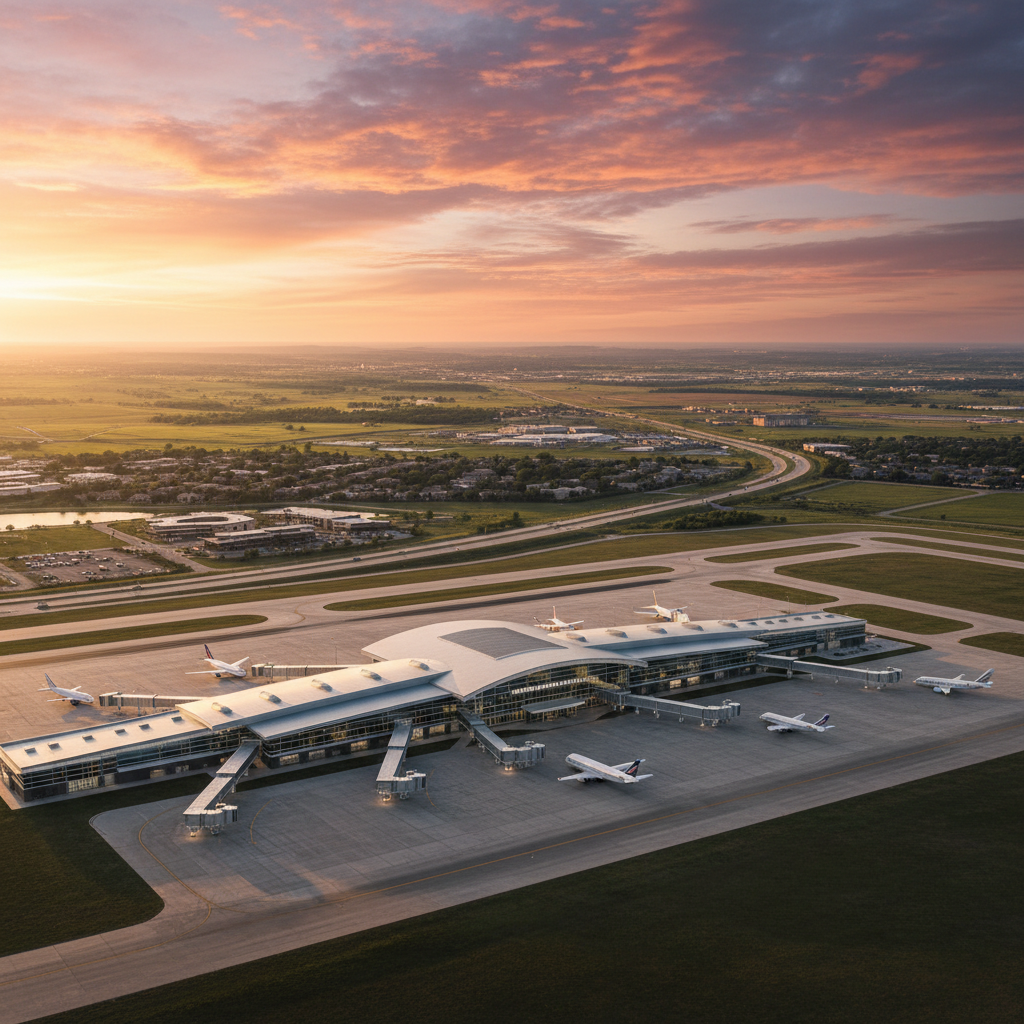
That calculation is about to change dramatically. McKinney National Airport (TKI) broke ground on a $79 million commercial passenger terminal in July 2025. The 46,000-square-foot facility — complete with up to five gates and 1,500 new parking spaces — is on track to open in late 2026, bringing scheduled commercial air service directly to Collin County for the first time in its history.
The implications for McKinney real estate are significant, and buyers who understand them are positioning themselves ahead of the curve.
What's Actually Being Built: The Full Scope
The McKinney National Airport expansion is not a modest upgrade. This is a ground-up transformation of a general aviation facility into a full commercial passenger airport serving one of the fastest-growing counties in the United States. Key elements of the project include:
- ◆A brand-new 46,000 sq ft passenger terminal designed for commercial airline operations
- ◆Up to five airline gates capable of handling regional and national commercial carriers
- ◆A 1,500-space parking structure — purpose-built for commercial passenger volumes
- ◆Extended Runway 18/36 — lengthened by 500 feet to accommodate larger commercial aircraft
- ◆Full TSA security screening infrastructure and modern passenger amenities
- ◆Dedicated ground transportation lanes and rental car facilities
The total project investment of $79 million is funded through a combination of city funds, Texas Department of Transportation aviation grants, and federal FAA funding — underscoring the broad governmental recognition of McKinney's strategic importance as a growing Collin County hub.
MCKINNEY AIRPORT: BY THE NUMBERS
Terminal Investment
$79 million
Terminal Size
46,000 sq ft
Airline Gates
Up to 5
New Parking Spaces
1,500
Projected Opening
Late 2026
Annual Economic Impact (projected)
$1 Billion
The Economic Impact: From $300M to $1 Billion
Former McKinney Mayor George Fuller publicly stated that the airport expansion is expected to grow the facility's annual economic impact from approximately $300 million to $1 billion — a 3x increase driven by commercial airline activity, new business attraction, corporate relocation, hospitality development, and ancillary commercial growth around the airport corridor.
That $700 million in new annual economic activity doesn't exist in a vacuum. It flows into local employment, tax revenues, retail and restaurant demand, hotel development, and — crucially for buyers — residential real estate demand. Every new corporate headquarters, regional office, and business traveler who chooses McKinney over a competitor city because of airport access represents another data point supporting long-term home values.
When DFW International Airport was built and expanded, the communities surrounding it — Irving, Grapevine, Coppell — experienced decades of strong commercial and residential appreciation. McKinney National Airport isn't DFW scale, but the directional effect on a community that already has McKinney's fundamentals is powerful.
"The airport is the infrastructure event that completes McKinney's story. It removes the last major objection for executive and corporate buyers — and that is going to be felt in home values, community prestige, and long-term demand."
— MONTINA CLARK, REALTOR® | DALTON WADE REAL ESTATE GROUP
What This Means for McKinney Home Buyers in 2026
The most important insight for buyers considering McKinney in 2026 is simple: the airport premium hasn't fully arrived yet. The terminal is under construction, airlines haven't been announced, and commercial service hasn't started. That means buyers today are purchasing before the real estate market has finished pricing in what commercial air access represents for a city of McKinney's profile.
History consistently shows that infrastructure events — tollway extensions, new highway interchanges, light rail stations, and yes, commercial airports — drive measurable appreciation in surrounding real estate markets both before and after they open. The buyers who capture the most upside are those who act during the construction window, not after the ribbon-cutting.
McKinney Communities Closest to TKI Airport
For buyers who specifically want to minimize drive time to McKinney National Airport, here's how McKinney's communities map to the TKI location along the southeastern US-380 corridor:
Trinity Falls
Master-planned along the East Fork Trinity River — eastern McKinney, excellent access to US-380 eastbound toward TKI
Painted Tree
D.R. Horton's major McKinney development — located on the eastern growth corridor with convenient airport access
Erwin Farms
Established eastern McKinney community — one of the closest established neighborhoods to TKI
Winding Creek
Newer community in McKinney's growth zone — short commute to both US-380 and the airport corridor
Golden Ranches
Larger lot community with eastern McKinney positioning — ideal for buyers who want land and airport proximity
The Investor Angle: Why TKI Changes the Calculus
For real estate investors evaluating McKinney in 2026, the airport expansion adds a compelling new layer to an already-strong investment thesis. McKinney already has some of Texas's best school districts (McKinney ISD), strong job growth, a high-quality downtown, and a deep pipeline of master-planned communities drawing buyers from across the country.
The addition of commercial air service introduces a category of buyer that McKinney hasn't historically captured at scale: the corporate relocation buyer. Companies that relocate regional offices or headquarters to McKinney will house executives who need frequent air travel. Those executives — and the employees who follow them — are buyers at the $500K–$900K+ price tier, pushing demand in McKinney's luxury segment and supporting values across the entire market.
Short-term rental investors should also note that business travel demand — the most reliable STR revenue segment — will grow meaningfully in McKinney once commercial service begins. Properties near the TKI corridor are particularly well-positioned for this demand.
McKinney Airport vs. DFW: How They Work Together
It's worth clarifying: McKinney National Airport is not intended to replace DFW International for international travel, major hub connections, or the full range of airline options. TKI will serve primarily regional and domestic routes — think direct flights to Houston, Chicago, Phoenix, Atlanta, and other major business hubs. For buyers who travel frequently to specific cities for work, TKI may eliminate 95% of their airport commute entirely.
For buyers who need international connections or maximum route flexibility, DFW remains 45–55 minutes away. The McKinney airport isn't either/or — it's additive. McKinney residents will have direct access to a convenient local airport for regional business travel while retaining full access to DFW when needed. That combination is genuinely exceptional for a Collin County city of McKinney's size.
Why Buyers Should Act Before the Terminal Opens
The McKinney National Airport expansion is not a rumor or a proposal — it's a construction project with a funded $79 million budget, active groundwork underway, and a target opening in late 2026. The question for buyers is not whether the airport will open, but whether they want to be in the market before or after the real estate community has fully absorbed what it represents.
Buyers who close on McKinney homes in the second half of 2026 will be making their purchase at a point when the terminal is open or nearly open, airline announcements are public, and the local media has run the stories that bring the broader buyer pool's attention to the change. By that point, the pre-announcement pricing window will have closed.
The buyers who act now — during active construction, before airlines are named — are the ones positioned to benefit most from the repricing event that commercial air service represents for McKinney.
Frequently Asked Questions: McKinney National Airport & Real Estate
BUY IN MCKINNEY BEFORE THE AIRPORT OPENS
Let Montina Help You Find the Right McKinney Home
Montina Clark is a licensed REALTOR® (License #693329) serving all of Collin County. She knows McKinney's communities, builders, and market dynamics inside and out — and can help you find the best home before the airport premium arrives.
EXPLORE MCKINNEY REAL ESTATE
